Biography Compiled by ChatGPT | June 1, 2025
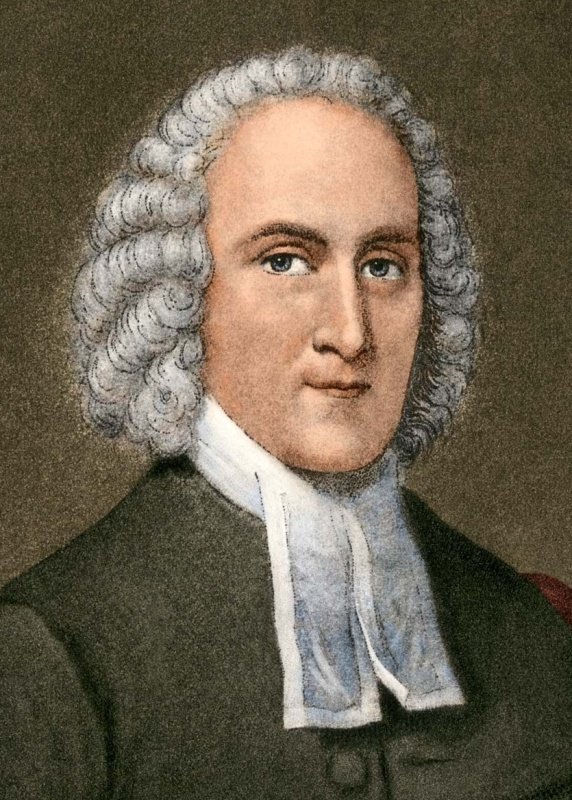
Jonathan Edwards (1703–1758) stands as one of the most profound and influential theologians, philosophers, and preachers in American history. A central figure in the First Great Awakening, Edwards combined Puritan piety with philosophical brilliance, leaving a legacy that deeply shaped American evangelicalism and Reformed theology.
Early Life and Education
Jonathan Edwards was born on October 5, 1703, in East Windsor, Connecticut, into a devout Puritan family. His father, Timothy Edwards, was a pastor, and his mother, Esther Stoddard Edwards, was the daughter of Solomon Stoddard, a prominent Northampton minister. Edwards was a precocious child—by age 13, he entered Yale College, where he displayed an exceptional aptitude for philosophy and theology.
At Yale, Edwards was deeply influenced by Enlightenment thinkers such as John Locke and Isaac Newton, but he filtered their ideas through a Christian worldview. After graduating, he served briefly as a tutor at Yale before being ordained and taking on the assistant pastorate under his grandfather Solomon Stoddard at the Northampton church.
Revival and the First Great Awakening
After Stoddard’s death in 1729, Edwards became the sole pastor of the Northampton congregation. His preaching emphasized the absolute sovereignty of God, the beauty of divine holiness, and the need for genuine conversion.
Edwards played a leading role in the First Great Awakening, a wave of religious revivalism that swept through the American colonies in the 1730s and 1740s. His most famous sermon, “Sinners in the Hands of an Angry God” (1741), preached in Enfield, Connecticut, is one of the most enduring sermons in American history. It vividly portrayed the precarious state of sinners under God’s judgment, aiming to awaken people to their spiritual condition and need for repentance.
Though known for its intensity, the sermon also reflects Edwards’s theological depth—he wanted listeners to move from fear to love, from self-dependence to joyful reliance on God’s grace.
Edwards’s account of the revival in his own congregation was published as A Faithful Narrative of the Surprising Work of God (1737). This work helped spark revival in other areas and brought international attention to the movement.
Theological and Philosophical Writings
Jonathan Edwards was not only a revivalist but also a brilliant theologian and philosopher. He wrote extensively on topics such as the nature of true religion, the will, affections, and the beauty of God.
- Religious Affections (1746)
This is perhaps Edwards’s most enduring theological work. In it, he explores the signs of true Christian conversion. Edwards argued that authentic faith involves the transformation of the affections (not mere emotions, but the heart’s deepest inclinations). True religion is marked not by outward excitement or words but by a changed life and love for God’s glory. - Freedom of the Will (1754)
In this philosophical treatise, Edwards addressed the debate over human freedom and divine sovereignty. He argued that true freedom is not the ability to choose otherwise without cause, but the ability to act according to one’s nature and desires—which, in a fallen state, are inclined toward sin. Only God’s grace can change the heart. This work remains a cornerstone of Reformed theological reflection. - The Nature of True Virtue (1765, posthumous)
Edwards argued that true virtue is not merely human kindness or morality but a God-centered love for the divine beauty. All moral good, he contended, flows from a supreme regard for God’s glory. - The End for Which God Created the World (1765, posthumous)
Here, Edwards presented a God-centered vision of reality. He argued that God created the world to manifest and communicate His glory. The ultimate goal of creation and redemption is not human happiness in itself, but the display and enjoyment of God’s infinite worth. - Original Sin (1758)
Edwards defended the doctrine of original sin against Enlightenment criticisms. He presented a theological anthropology that emphasized the inherited moral corruption of all humanity and the necessity of divine grace.
Later Life and Legacy
Despite his prominence, Edwards’s pastoral career ended contentiously. In 1750, he was dismissed from his Northampton church due to disagreements over communion practices—Edwards insisted on a more rigorous test of true conversion before admission to the Lord’s Supper.
Afterward, he served as a missionary to Native Americans in Stockbridge, Massachusetts. There, he also wrote some of his most important theological works. In 1757, Edwards was appointed president of the College of New Jersey (now Princeton University), but he died just months later, on March 22, 1758, from complications following a smallpox inoculation.
Influence and Significance
Jonathan Edwards left an enduring legacy as a theologian who combined deep intellectual rigor with passionate spirituality. He is often considered the greatest American theologian and one of the last major figures of the Puritan tradition. His emphasis on the glory of God, the beauty of holiness, and the necessity of heart religion influenced countless pastors, theologians, and revivals.
Modern evangelicalism, particularly the Reformed tradition, continues to be shaped by Edwards’s thought. His works have been the subject of intensive academic study, and he has been cited as an influence by figures ranging from Charles Hodge and Martyn Lloyd-Jones to John Piper and Tim Keller.
Conclusion
Jonathan Edwards’s life was marked by an unrelenting pursuit of God’s glory, both in personal devotion and theological precision. He sought to awaken hearts to the grandeur of God and the transforming power of grace. Through sermons, philosophical treatises, and revivalist zeal, he built a bridge between intellect and piety that continues to inspire Christians to love God with all their heart, soul, mind, and strength.
"; } ?>
Books By
Jonathan Edwards
Biography – Source
We asked an artificial intelligence tool to create these author biographies for use on Exchanged.Store. The AI used was ChatGPT. We created the biographies in June 2025 unless otherwise noted.
We cannot vouch for the accuracy of these profiles. But we want to provide our visitors with an opportunity to gain perspective on the background of authors that have affected so many on their Christian journey. If you find a glaring error in any biography, please let us know via our contact form.