Biography Compiled by ChatGP | June 1, 2025
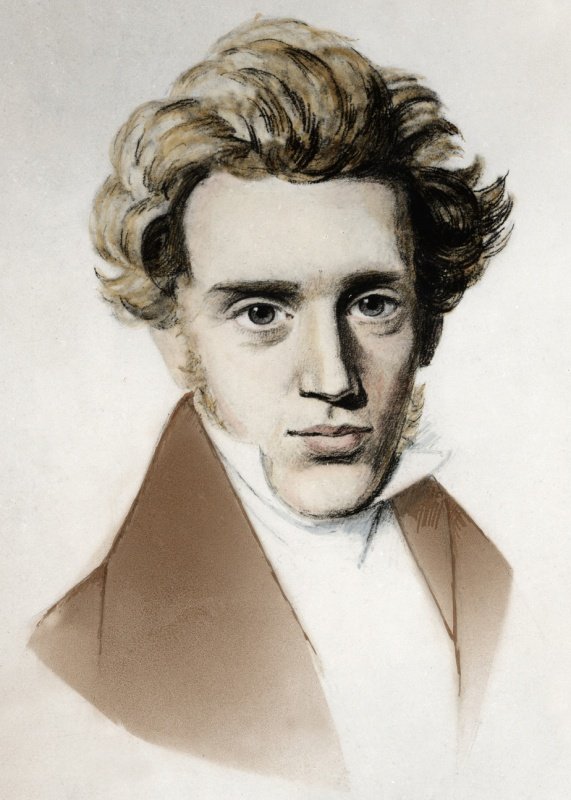
Søren Kierkegaard: The Father of Existential Christianity
Søren Aabye Kierkegaard (1813–1855) was a Danish philosopher, theologian, and writer whose groundbreaking work laid the foundations for existentialism and profoundly shaped modern Christian thought. Known as the “father of existentialism,” Kierkegaard’s writings explore the nature of faith, the human condition, and the individual’s relationship with God. His Christian writings challenge believers to live authentically and passionately in their faith, emphasizing the importance of personal choice, commitment, and subjective experience.
Early Life and Background
Kierkegaard was born on May 5, 1813, in Copenhagen, Denmark, into a wealthy and devout Lutheran family. His father, Michael Pedersen Kierkegaard, was a deeply religious man whose stern nature and intense pietism left a lasting impression on Søren. The complex relationship between father and son and the early loss of several siblings profoundly influenced Kierkegaard’s worldview, shaping his reflections on despair, sin, and grace.
Educated at the University of Copenhagen, Kierkegaard studied theology and philosophy but soon diverged from the dominant Hegelian philosophy of the time. He was deeply dissatisfied with the prevailing rationalist and institutional approaches to Christianity and sought to reclaim the existential, inward dimension of faith.
Major Themes in Kierkegaard’s Christian Thought
Kierkegaard’s writings are rich and complex, often written under pseudonyms to explore different viewpoints and provoke reflection. Central to his thought is the tension between objective knowledge and subjective truth, especially in matters of faith.
Subjective Truth and the Individual
Kierkegaard argued that Christianity is not merely a set of doctrines or historical facts but a personal, existential commitment. He famously claimed that “truth is subjectivity,” meaning that the deepest truths are realized only in the passionate, inward engagement of the individual with God.
Faith, for Kierkegaard, requires a “leap” beyond reason and evidence—a courageous, subjective choice to trust God despite uncertainty and doubt. This leap is not irrational but involves embracing paradox and living in paradox, especially the paradox of the incarnation—that God became human in Jesus Christ.
The Stages of Life’s Way
In works such as Either/Or (1843), Kierkegaard outlines three existential stages or modes of existence:
- The Aesthetic Stage: A life lived for pleasure, beauty, and personal gratification, often marked by despair due to its emptiness.
- The Ethical Stage: A life committed to moral responsibility and social duty.
- The Religious Stage: The highest stage, characterized by a personal relationship with God through faith, which transcends ethics and aesthetics.
The Christian life, Kierkegaard taught, involves movement toward the religious stage, which demands a paradoxical faith and total surrender to God.
Key Christian Writings
Kierkegaard’s Christian writings include a variety of books, essays, and journals. Some of his most influential works are:
- Fear and Trembling (1843): Written under the pseudonym Johannes de Silentio, this book reflects on the biblical story of Abraham’s willingness to sacrifice Isaac. Kierkegaard explores the nature of faith as a “teleological suspension of the ethical,” where obedience to God transcends human ethics and reason. The work highlights the existential anxiety and paradox inherent in true faith.
- The Concept of Anxiety (1844): Here, Kierkegaard examines the nature of sin and the experience of anxiety as the “dizziness of freedom,” which arises from the human awareness of choice and possibility.
- Works of Love (1847): In this profound meditation on Christian love (agape), Kierkegaard emphasizes love as the central Christian virtue that transcends emotion and ethical duty. Love is an expression of God’s grace and commands believers to love their neighbor unconditionally.
- Practice in Christianity (1850): This book challenges superficial religion and calls for an authentic, lived Christianity marked by self-denial, humility, and imitation of Christ.
Relationship with the Church and Society
Kierkegaard was often critical of the established Church of Denmark, which he saw as complacent, institutionalized, and lacking genuine faith. He believed the Church had become too comfortable with cultural Christianity and neglected the radical demands of the gospel.
His critiques were sharp and controversial, contributing to his relative isolation during his lifetime. Yet, his challenge to individual faith and authenticity has resonated through the centuries as a call to a deeper, more passionate Christianity.
Legacy and Influence
Although Kierkegaard died relatively young at 42 in 1855, his influence has grown tremendously over time. He is considered a foundational figure in existential philosophy and theology. His emphasis on personal responsibility, faith as a subjective truth, and the existential realities of despair, anxiety, and hope continue to speak powerfully to both Christian and secular audiences.
Kierkegaard’s writings have influenced a broad spectrum of thinkers, including theologians like Karl Barth and Paul Tillich, existentialist philosophers such as Jean-Paul Sartre and Martin Heidegger, and contemporary Christian writers exploring spirituality and discipleship.
Conclusion
Søren Kierkegaard remains one of Christianity’s most profound and challenging voices. His writings call readers beyond complacency and intellectual assent to a lived faith marked by passion, paradox, and personal commitment. By insisting that true Christianity demands a “leap of faith” and a life oriented entirely toward God, Kierkegaard invites believers to confront their own existence, embrace uncertainty, and discover the transformative power of faith.
His legacy endures as a beacon for those seeking an authentic encounter with God amid the complexities of modern life.
"; } ?>
Books By
Søren Kierkegaard
Biography – Source
We asked an artificial intelligence tool to create these author biographies for use on Exchanged.Store. The AI used was ChatGPT. We created the biographies in June 2025 unless otherwise noted.
We cannot vouch for the accuracy of these profiles. But we want to provide our visitors with an opportunity to gain perspective on the background of authors that have affected so many on their Christian journey. If you find a glaring error in any biography, please let us know via our contact form.